
Confidence · 25 August 2026 · 4 min read
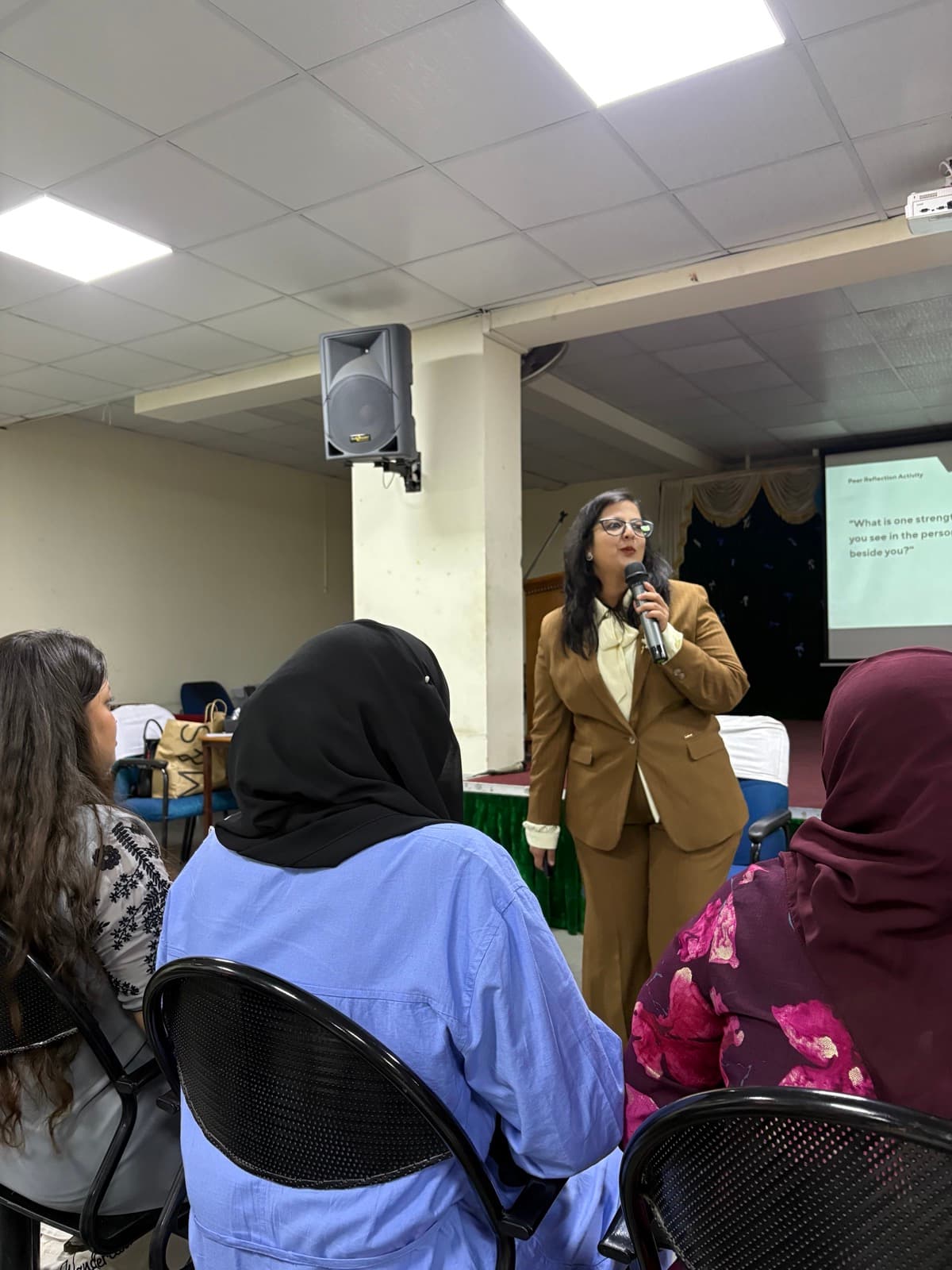
People come to me asking for better English. Almost always, vocabulary is not the thing that is missing.
The request arrives in more or less the same words every time. "My English is weak." "I want to improve my communication." "I need better vocabulary." And then, in the first session, the person speaks — carefully, correctly, with a perfectly adequate vocabulary — and it becomes clear that the words were never the problem.
What is actually happening is usually this: they can speak. They cannot speak while being watched.
The request behind the request
"My English is weak" is often the only socially acceptable way to say something much harder to admit — that speaking up in a meeting is frightening, that they have opinions they never voice, that they suspect they are the least capable person in the room and would rather not prove it out loud.
Vocabulary is a comfortable diagnosis because it comes with a comfortable cure. Buy a book. Learn ten words a day. It feels like progress and it demands nothing emotionally. The trouble is that it treats a problem the person does not have.
Why more words can make it worse
There is a loop that anyone who has been self-conscious in a second language will recognise. You start a sentence. Halfway through, some part of your attention peels off to check whether the sentence is correct. That checking costs you the next few words. You hesitate. The hesitation confirms your fear that you are not fluent, which makes the checking louder, which produces more hesitation.
Now add a larger vocabulary to that loop. You have not removed the monitor; you have given it more to evaluate. More choices, more second-guessing, more pauses in exactly the places where fluency is judged. I have watched people get measurably less fluent after a month of word lists, and be quietly devastated by it.
What confidence actually means here
It is worth being precise, because the word carries a lot of unhelpful baggage. Confidence in this context is not volume. It is not extroversion, or charisma, or being the first to speak. Some of the most authoritative people I have trained are quiet, and their quietness is part of why they are listened to.
It is something narrower: the working belief that what you are about to say is worth the time it takes to say it. That belief is what lets you finish a sentence without checking it mid-flight. Everything people describe as fluency — pace, pauses, steady eye contact, a voice that lands at the end — follows from it almost automatically.
Fluency is not the cause of confidence. It is what confidence looks like from the outside.
Four things that actually move it
Finish the sentence, even when it is wrong. This is the first thing I ask for, and the hardest. Say it all the way to the end, mistake and all. The habit you are building is not accuracy; it is completion. Accuracy comes back later, and it comes back faster in someone who is not abandoning half their sentences.
Slow down by about a fifth. Nervous speech accelerates. Speed removes your own thinking time, so you reach for whatever word is nearest, which is usually the weaker one. Slowing down feels excruciating for the first week and sounds, to everyone else, like authority.
Own the pause instead of filling it. The gap between two sentences belongs to you. Filling it with "basically", "actually", "you know" hands it back. A silent pause is read as thinking; a filled one is read as floundering. Same gap, opposite conclusion.
Separate practice from performance. Most people only ever speak when it counts — in the meeting, in the review, in the interview. That is like only ever swimming in deep water. Rehearse out loud when nothing is at stake, so that when something is, the mechanics are already there and your attention is free for the content.
The order that works
Belief first, then habit, then language. Get someone to believe their point is worth making, and they will start making it. Get them making it regularly, and the mechanics steady. Only then does vocabulary work do anything, because now there is something for it to sharpen rather than something for it to obstruct.
Reversing that order is the most common mistake in communication training, and it is why so many people have done three courses and still cannot speak in a meeting. They were given tools for a problem they did not have, and no help at all with the one they did.
This is what I mean by quiet authority. Not learning to sound like someone else. Learning that the person you already are has something worth saying — and then getting the mechanics out of the way so the room can hear it.

Prachee Gupta
Corporate & Campus-to-Corporate Trainer. I build confidence first, then layer the communication skills on top — for corporate teams, campus cohorts and individuals.
Book a free consultation